

You can return any time by using the sub-menu at the top of your screen.
Share this


How to Design An In-Ground Pool Deck
An in-ground pool greatly expands the enjoyment potential of your backyard. Nothing is more inviting than that glistening water on a hot summer day. But what about the deck surrounding your pool?
Aesthetically, the decking defines your refreshing oasis. It can enhance your landscaping and effectively tie in other elements such as a fire pit and pathways. From a practical standpoint, pool decking provides a safe, comfortable walking area for swimmers, as well as a place for poolside loungers.
Best Pool Deck Products
The best decking option for a pool area is Unilock pavers, engineered to provide reliable traction even when wet and to stay noticeably cooler under direct sun. Consider these popular Unilock choices:
Umbriano
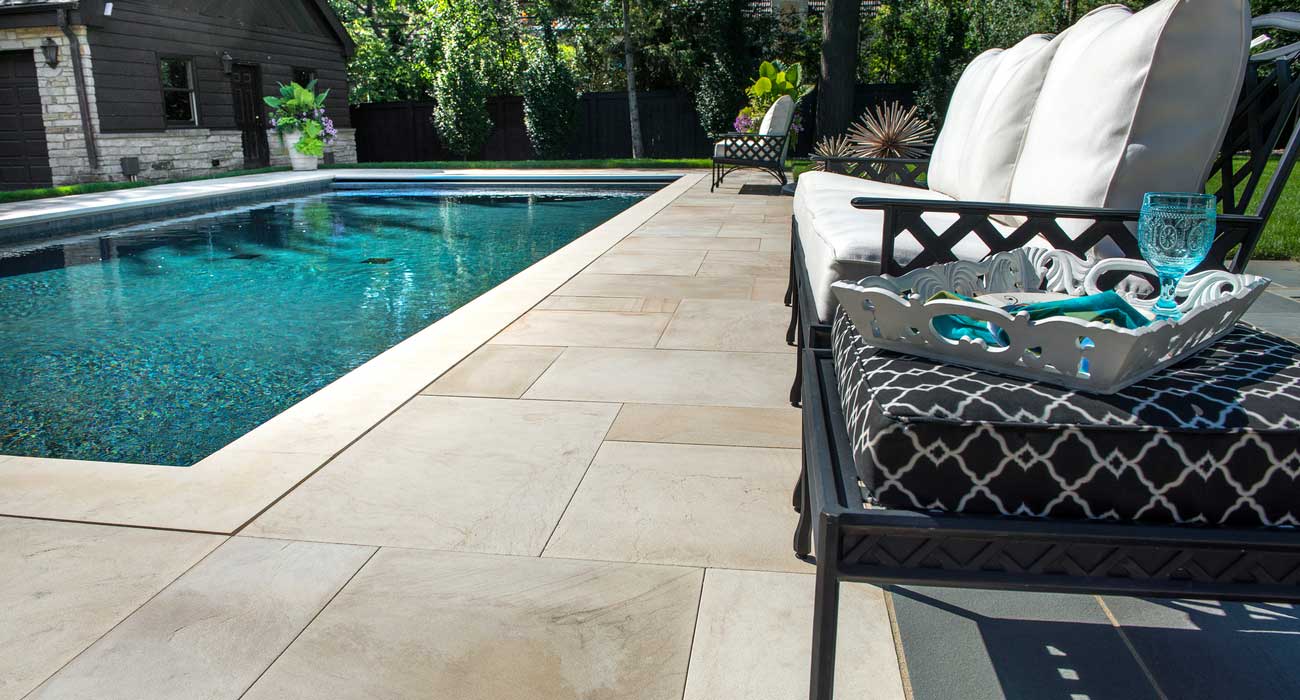
The unique, mottled surface with granite particles gives Umbriano a natural, non-slip texture, making it a popular choice for pool decks.
Beacon Hill Smooth
With extra-large sizes and a contemporary color palette, including lighter shades that help keep your deck cool on your feet, Beacon Hill Smooth creates a sleek, modern pool surround.
Arcana
Arcana’s large-format pavers have a silky, matte texture and a speckled appearance of natural granite, quartz, and marble particles, creating a stunning surface that also provides a safe grip for wet foot traffic.
Best Pool Coping Material
When selecting material for pool coping, natural stone products such as Ledgestone,Granite and Limestone are the best choices. Not only does natural stone coping add a touch of elegance to your pool deck, it is also cool to the touch, durable and strong, and has low water absorption.
Pool coping is the protective lip or cap at the top of the pool wall that finishes off the look. Coping has other purposes, such as keeping debris from entering your pool, helping swimmers enter and exit the pool safely, and reducing the risk of slipping around the pool edge.
Keep Your Pool Deck Cool
The coolest pool deck surface is made from pavers. Swimmers commonly have bare feet when walking around the pool area, and a paver deck will allow them to walk safely on a deck that provides a good grip and is pleasantly cool for tender tootsies.
When considering pavers, look for a product that is light in color, such as Umbriano Summer Wheat or Winter Marvel. Umbriano stays cool and has a natural, non-slip texture thanks to the unique mottled surface with granite particles. Be sure to complement your decking with a light, natural-colored coping material as well.
Are pavers or concrete better for pool decking?
While poured concrete is commonly used around inground pools, pavers are a better option for pool decking – when installed properly.
Concrete is more likely to crack, which can be costly to repair. A large area around the damage must be professionally cut, removed, and the concrete must be re-poured, which can be very disruptive. Moreover, if your concrete is colored, the color will fade over time, making color-matching difficult – if not impossible.
Pavers come in many colors and patterns, offering more creative options. They are designed to hold up well over time, even tolerating harsh freeze/thaw cycles. If a stone needs to be replaced, it’s as simple as removing it and replacing it with a new matching stone from the same line. Pavers are also unaffected by chlorine and other pool chemicals.
Now that you have the information you need, the next step is to talk to a Unilock Authorized Contractor to help you plan a deck that will make your inground pool the summer retreat of your dreams.
Frequently Asked
Questions
Do pavers get hotter than concrete?
Both pavers and concrete will get hot from the sun. That’s why it is advisable to choose pavers in lighter shades. Light-colored pavers won’t absorb the sun’s rays, and they will stay much cooler to the touch.
Which lasts longer: concrete or pavers?
Typically, pavers last longer than concrete because they are less susceptible to damage from ice, winter heaving, and salt. Pavers are also 2.5 times stronger than poured concrete. Concrete often fades or chips away with time, especially in cold climates. When the temperatures drop to below freezing, moisture in the concrete can expand, creating pressure and damaging the surface layer, which can look unsightly over the years.
Is it cheaper to pour concrete or use pavers?
Plain poured concrete is cheaper than pavers because it is exactly that – plain. It has no color, no texture, and no real aesthetic value.
How much does it cost to put pavers around a pool?
To put pavers around a pool typically starts at approximately $20 per square foot installed. However, that cost can be affected by factors such as property access, excavation requirements, retaining requirements, paver type and your deck design.
Related
Articles
We’re Here To Help
We make it easy to get inspired, plan, and start your project.

See our Catalog of Dreams
Explore ideas, spark inspiration, and see our full range of Unilock products.

Get your freeestimate today
Partner with a Unilock Authorized Contractor for best-in-class results.

Plan your dream project beautifully
Excited to start a new project? Get our Project Planning Guide and plan with ease.