

You can return any time by using the sub-menu at the top of your screen.

Share this


Plastic vs. Concrete Paver Edge Restraints: Which Is Better for Your Project?
Unilock pavers are engineered to withstand the harshest seasonal climates, but it’s the paver edge restraints working behind the scenes that play a critical role in preserving the integrity of your project. These restraints are essential for maintaining the shape and structure of your design by preventing the lateral movement of pavers.
While choosing the right edge restraint might not be at the top of your list, it can be just as important as selecting the pavers themselves. The two most common types that are used across most applications are plastic and modified concrete. So, how do you know which one is best for your project? In this article, we’ll explore the differences between them, highlight their pros and cons, and guide you toward the right solution for your specific needs.
What are Plastic Edge Restraints and How to Install Them
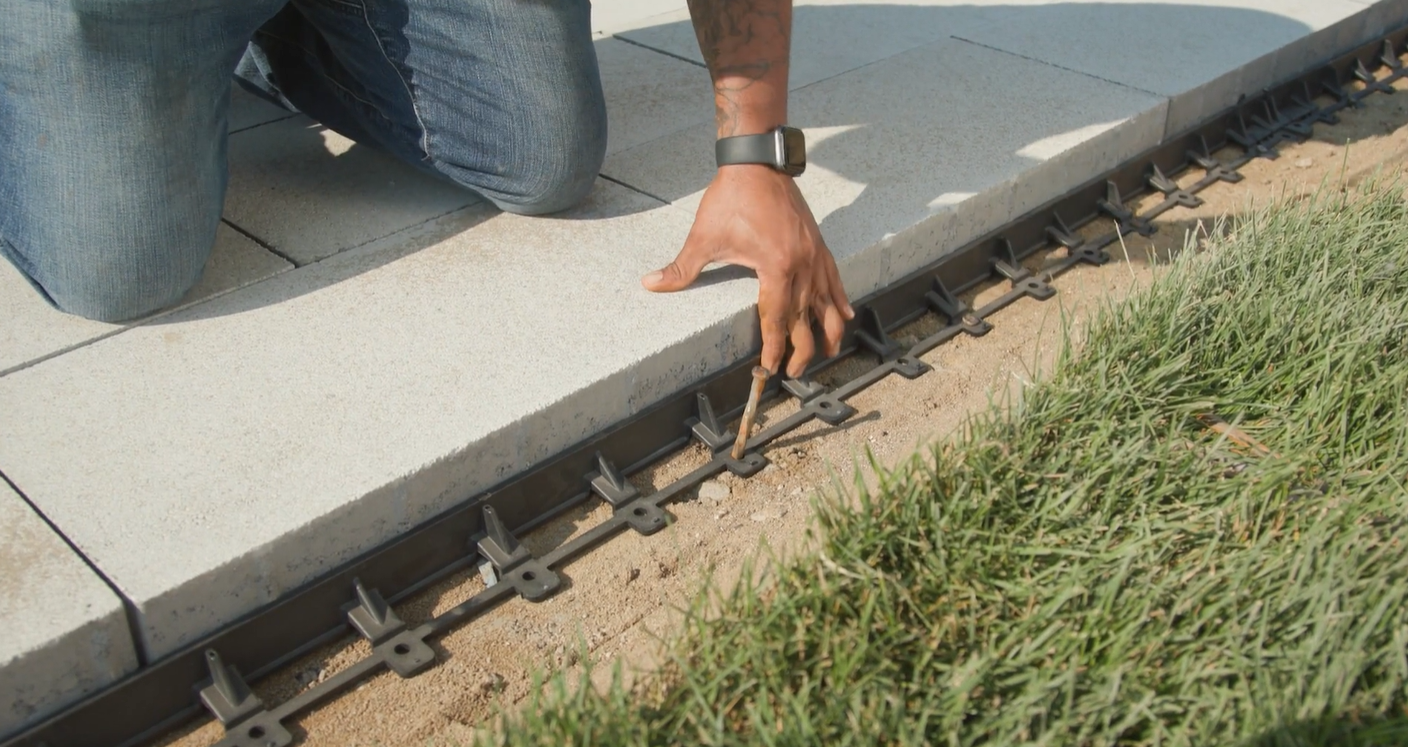
Plastic edge restraints are a flexible, lightweight edging solution that is secured using a hammer and non-galvanized metal spikes. These spikes are recommended because of their natural rusting properties, which allow them to “lock” into place to enhance the long-term stability of the restraint.
To install plastic edging, begin by scraping back the bedding layer along the edges of your project until you reach the solid, compacted base underneath. Once you’ve exposed the base, place the plastic edging so it sits about ½” below the top of your pavers. If it’s set too high or too low, it could affect the stability of your design and lead to shifting over time as the ground settles. It’s important that the edging rests directly on the base and not the bedding material itself. That’s because the bedding is designed to settle slightly after installation. Any movement may cause the restraints and eventually the pavers to shift, compromising the project’s structural integrity.
Next, use a hammer to gently tap the metal spikes into the holes along the edging, stopping about ¼” above the collar. This helps the spikes rust naturally and lock in place for a stronger hold. Driving the spikes too far can disrupt the compacted material underneath and weaken the restraint’s strength.
NOTE: Plastic edge restraints are not suitable for open-graded or permeable bases, as they lack the fine particles needed to secure the spikes effectively. Instead, we recommend using a modified concrete edge restraint for these types of projects.
Pros and Cons of Plastic Edge Restraints
Now that you know the basics of installing plastic edge restraints, let’s dive into the pros and cons of using them for your project.
Pros:
Flexible Design: The plastic mold can accommodate both straight lines and curved edges.
Durability: Securing edge restraints with non-galvanized spikes allows the natural rusting process to take effect, ensuring a stable, long-lasting hold.
Ease of Installation: Plastic edge restraints feature pre-drilled holes that allow for quick and easy installation.
Lightweight: Their lightweight construction makes them easy to handle, position, and secure on your project.
Cons:
Only Compatible with Traditional Bases: Plastic edge restraints work best with traditional bases, like ¾” minus crusher run gravel (ASTM D 2940). This is because they contain a mix of stone and fines that can secure the spikes in place.
Potential for “Creep”: Over time, seasonal freeze/thaw cycles can cause pavers to shift or heave, leading to uneven surfaces or tripping hazards.
Spikes Can Shift: Improper installation can cause spikes to loosen or shift, reducing the effectiveness of the edge restraint.
Ongoing Maintenance: Regular seasonal inspections are recommended to ensure the restraints remain secure.

What are Concrete Edge Restraints and How to Install Them
Concrete edge restraints—also known as modified concrete edging—are made from a blend of high-performance polymers, microfibers, cement, and water. This creates a durable, moldable concrete mixture that can be applied along the perimeter of your project to secure pavers in place.
The installation process begins similarly to plastic edging, as you’ll need to scrape back the bedding layer to expose the compacted base. However, concrete edging requires on-site mixing of water with a dry concrete blend to create the material. Always follow the manufacturer’s instructions, as water-to-mix ratios may vary depending on the brand. For example, with Alliance Gator Xtreme Edge, the recommended mixture is ½ US gallon (1.9 liters) of water to one 50 lb bag of dry mix.
Once blended thoroughly, use a flat concrete trowel to apply the mix along the edge of the paver field. Make sure to tuck the mix slightly under the pavers, then smooth it out into a wedge shape that slopes upward at about a 30-degree angle. The wedge should stop about ½” below the surface of the pavers. This shape helps lock the pavers in place while maintaining a clean finish.
Pros and Cons of Concrete Edge Restraints
Let’s take a look at the advantages and potential drawbacks of using concrete edging.
Pros:
Durability: Concrete edging is more rigid than plastic, offering strong resistance against paver shifting over time.
Flexibility: The combination of concrete and water creates a moldable material that can bond directly against the pavers to create a long-lasting hold.
Easy to Install: The application only requires a bag of concrete mix, water, a hand shovel, and a flat concrete trowel to create a functional edge.
Cost-Efficient: Modified concrete edging is more affordable than plastic, especially for larger projects.
Cons:
Additional Labor: Mixing, applying, and shaping the concrete takes more time and effort, compared to plastic edging.
Messier Installation: Working with wet concrete can be messier and requires additional cleanup.
Potential for Cracking: Concrete edging can develop cracks or chips due to harsh freeze/thaw cycles. That’s why it’s important to perform regular inspections at the start of each season so you can catch potential problems early.
Curing Time Required: After installation, the concrete will need time to fully cure before reaching its full strength. However, compaction and joint sand application can still occur during this time.
Edge restraints are vital to the structural integrity and longevity of any paver installation. The only exception is when your pavers are installed against a fixed structure, such as a foundation, planter, step, or retaining wall. For all other projects, selecting the right type of restraint depends largely on your base material. Plastic edge restraints are an excellent choice for traditional gravel bases that include both stone and fines. Alternatively, concrete edge restraints provide more flexibility for different base types, including open-graded systems, but come with added installation complexity and potential long-term maintenance.
If you’re unsure which restraint to choose, we recommend consulting a Unilock Authorized Contractor. These experienced professionals understand the nuances of base preparation, paver installation, and edge restraint selection. With their expert guidance, you can ensure your outdoor space will remain strong, stable, and stunning for years to come.
Related
Articles
We’re Here To Help
We make it easy to get inspired, plan, and start your project.

See our Catalog of Dreams
Explore ideas, spark inspiration, and see our full range of Unilock products.

Get your freeestimate today
Partner with a Unilock Authorized Contractor for best-in-class results.

Plan your dream project beautifully
Excited to start a new project? Get our Project Planning Guide and plan with ease.